
At a glance
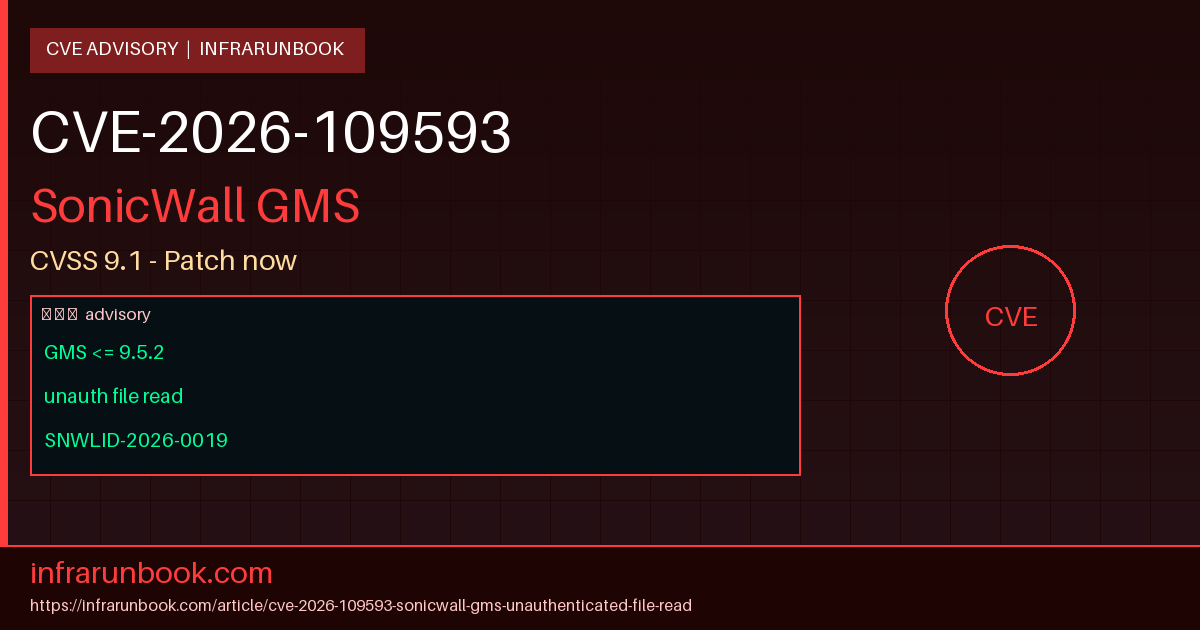
- CVE ID(s): CVE-2026-109593
- Severity: CVSS 9.1 CRITICAL (score from CISA-ADP). Vector: CVSS:3.1/AV:N/AC:L/PR:N/UI:N/S:U/C:H/I:N/A:H
- Vendor / product: SonicWall / Global Management System (GMS), Windows and Linux
- Affected versions: 9.5.2 and earlier versions
- Fixed / patched versions: Not stated in the advisory - check the vendor page
- Exploited in the wild: No known exploitation (not listed in CISA KEV)
- Attack vector: Network. No authentication needed. No user interaction.
- Published by: sonicwall (CNA), published 2026-11-03
- Official advisory: SNWLID-2026-0019
What is this vulnerability?
CVE-2026-109593 is a flaw in SonicWall Global Management System (GMS). SonicWall says an unauthenticated attacker with network access to GMS 9.5.2 or earlier may be able to read internal GMS files. This could expose sensitive information.
The record lists the weakness as CWE-636. The record gives no further technical detail. It does not say which files are reachable, which component is affected, or how the flaw is triggered. Do not assume more than that.
How does it affect you?
The main risk is disclosure of sensitive data. GMS manages SonicWall devices, so its internal files may hold information that is valuable to an attacker. The record does not say what those files contain. Treat the possibility of configuration data or credentials being exposed as a planning assumption, not a confirmed fact.
The CVSS vector scores confidentiality and availability impact as High and integrity impact as None. The description only talks about reading files. The record does not explain the availability rating. Use the score as given and read the vendor advisory for detail.
Realistic risk depends on exposure. The attack needs no login and no user action. Any host that can reach your GMS can try it. A GMS reachable from the internet or from broad internal networks is at higher risk than one limited to a small management network.
No exploitation is known. The record shows it is not in CISA's KEV catalog. That can change, so do not treat it as a reason to wait.
Who is affected?
- Anyone running SonicWall GMS 9.5.2 or any earlier version.
- Both the Windows and Linux platforms are listed.
- The record sets the default status to unknown. It lists only the 9.5.2 and earlier range as affected. Versions newer than 9.5.2 are not confirmed as safe or unsafe in the record. Check the advisory.
How to check if you are vulnerable
- Open the GMS web interface and note the installed version. Check the system or about information in the console.
- Compare it with the affected range: 9.5.2 and earlier.
- If the version is 9.5.2 or older, treat the system as vulnerable.
- Find out who can reach GMS over the network. Review firewall rules, NAT rules and any internet exposure for the GMS host.
- Open the vendor advisory and confirm the affected and fixed builds for your deployment.
I am not giving CLI commands. The record does not include them, and the exact syntax depends on how GMS is deployed.
How to fix and recover
The record lists no solutions and no fixed version. Fixed version: Not stated in the advisory - check the vendor page.
- Read SNWLID-2026-0019 for the patch or upgrade path.
- Take a backup of the GMS configuration before changes.
- Apply the vendor's fix or upgrade as the advisory describes.
- After patching, confirm the new version in the console. Confirm GMS still manages your devices as expected.
If GMS was reachable by untrusted hosts before you patched, consider that files may have been read. The record does not confirm any exploitation. A cautious response is reasonable:
- Review GMS and network logs for unusual access from unexpected sources.
- Consider rotating credentials, keys and shared secrets that GMS stores or uses. Follow the vendor's guidance on what to rotate.
- If you find signs of compromise, restore from a known-good configuration and investigate before returning the system to service.
Workarounds and mitigations
The record lists no workarounds. These general steps reduce exposure while you wait for or apply the fix:
- Remove GMS from direct internet exposure.
- Limit network access to GMS to a small set of trusted management hosts, using firewall rules or an access control list.
- Place GMS on a dedicated management network.
- Check the vendor advisory for any official interim guidance.
These steps lower risk. They do not fix the flaw.
What to monitor
- Unexpected requests to the GMS web service from hosts outside your management network.
- Spikes in requests from a single source, or requests that return unusual responses.
- New or changed admin accounts, and logins from unfamiliar addresses, which could follow stolen credentials.
- Changes to the managed SonicWall devices that you did not make.
- Updates to the SonicWall advisory and to the CISA KEV catalog for this CVE.