
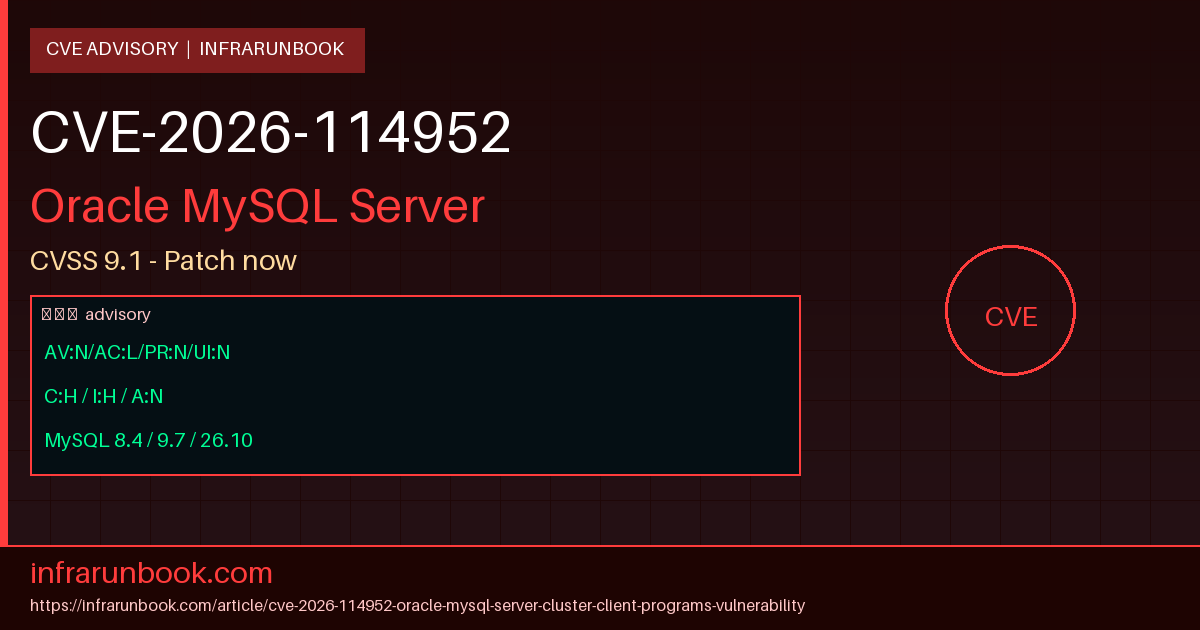
At a glance
- CVE ID: CVE-2026-114952
- Severity: CVSS 3.1 Base Score 9.1, CRITICAL. Vector: CVSS:3.1/AV:N/AC:L/PR:N/UI:N/S:U/C:H/I:H/A:N
- Vendor / product: Oracle Corporation. MySQL Server and MySQL Cluster (component: Client programs)
- Affected versions: MySQL Server 8.4.0-8.4.13, 9.7.0-9.7.4 and 26.10. MySQL Cluster 8.0.0-8.0.50, 8.4.0-8.4.13, 9.7.0-9.7.4 and 26.10
- Fixed / patched versions: Not stated in the advisory - check the vendor page
- Exploited in the wild: No known exploitation
- Attack vector: Network. No authentication needed. No user interaction needed. Attack complexity is low.
- Published by: Oracle (CNA), 2026-11-17
- Official advisory: Oracle Critical Security Patch Update Advisory - November 2026
What is this vulnerability?
CVE-2026-114952 is a vulnerability in the Client programs component of Oracle MySQL Server and MySQL Cluster. Oracle rates it CVSS 3.1 9.1 (Critical).
Oracle calls it "easily exploitable". An unauthenticated attacker with network access can exploit it over multiple protocols. The attacker does not need valid credentials, and no user has to click anything or take any other action.
Oracle has not published technical root-cause details. The CVE record does not name a specific weakness class (CWE). The advisory names only the component (Client programs), the access conditions and the impact. We do not speculate beyond that here.
Oracle fixed this in its November 2026 Critical Security Patch Update (CSPU). Oracle describes a CSPU as a smaller, targeted release of high-priority fixes. It complements Oracle's quarterly Critical Patch Updates.
How does it affect you?
The CVSS vector sets out the risk:
- Confidentiality: High. An attacker can get unauthorized access to critical data, or complete access to all data that MySQL Server or MySQL Cluster can reach.
- Integrity: High. An attacker can create, delete or modify critical data, or all accessible data.
- Availability: None. Oracle does not list service disruption as a direct impact. Deleted or corrupted data can still cause an outage in practice.
- Scope: Unchanged. The impact stays within the affected MySQL component.
In practice, a successful attack could lead to theft of the database's contents, silent changes to records, or destroyed data. Databases often hold customer records, application credentials and financial data. A full read/write compromise of that data is serious.
Realistic risk depends heavily on network exposure. Any affected instance that untrusted networks can reach is at the highest risk, especially one reachable from the internet. Instances that only localhost or a tightly filtered application tier can reach are less exposed. They still need to be patched, because an attacker with a foothold elsewhere in your network could reach them.
At publication, this CVE is not listed as exploited in the wild. Oracle's advisory notes that attackers often succeed against customers who failed to apply patches that were already available. Do not wait for exploitation reports before you patch.
Who is affected?
You are affected if you run any of these versions:
- MySQL Server: 8.4.0 through 8.4.13, 9.7.0 through 9.7.4, and 26.10
- MySQL Cluster: 8.0.0 through 8.0.50, 8.4.0 through 8.4.13, 9.7.0 through 9.7.4, and 26.10
Note the difference between the two products. The record lists the 8.0 line (8.0.0-8.0.50) as affected for MySQL Cluster, but not for MySQL Server.
Oracle lists only supported versions. If you run an older or end-of-life release line, it was not assessed. Do not assume it is safe. Plan to move to a supported, patched release.
The vulnerable component is Client programs. These binaries usually ship alongside the server in standard packages. Check every host where MySQL packages are installed, not only dedicated database servers.
How to check if you are vulnerable
First, find every MySQL Server and MySQL Cluster instance in your environment. Include containers, VMs, appliances and developer machines.
On each host, check the installed client and server versions:
mysql --version
mysqld --version
From an SQL session, check the running server version:
SELECT VERSION();Compare the output with the affected ranges above. A version inside a listed range means you are affected.
Next, check network exposure. See which address the server listens on:
SHOW VARIABLES LIKE 'bind_address';On Linux, list the listening sockets for MySQL processes:
ss -tlnp | grep mysqldOracle says the flaw is exploitable over multiple protocols. Check every MySQL listener, not only the classic protocol port. If you use MySQL Cluster, also check the management and data node hosts. Review firewall rules and cloud security groups to confirm which source networks can reach each listener.
How to fix and recover
- Get the patch. Open the November 2026 CSPU advisory and follow the MySQL Patch Availability Document. The CVE record does not state the fixed version numbers. Check the vendor page for the exact release for your branch.
- Prioritize by exposure. Patch internet-facing and widely reachable instances first. Patch internal-only instances next.
- Upgrade server and client packages together. The flaw is in Client programs. Make sure the updated client binaries are installed on every host, including application servers and admin workstations that have MySQL packages.
- Follow your normal upgrade process. Take a verified backup first. Test on staging. For replication setups and MySQL Cluster, follow Oracle's documented rolling upgrade order.
- Verify after patching. Run
mysql --version
,mysqld --version
andSELECT VERSION();
again. Confirm that every instance now reports a version outside the affected ranges.
If an affected instance was reachable from untrusted networks, assume it may have been compromised and take these recovery steps:
- Rotate MySQL account passwords, especially for privileged and application accounts.
- Rotate any secrets stored in the database, such as API keys, tokens and credentials used by your applications.
- Review accounts and grants. Remove any users or privileges you cannot explain.
- Check data integrity against backups or application-level checksums.
- If you find tampering, restore data and configuration from a known-good backup taken before the suspected compromise.
Workarounds and mitigations
Oracle has published no workarounds. The record's workaround and solution fields are empty. Patching is the fix. Until you can patch, reduce exposure:
- Restrict network access. Allow MySQL ports only from the specific application hosts and admin networks that need them. Block all other sources at the host firewall and network edge.
- Never expose MySQL directly to the internet. Put remote administration behind a VPN or bastion host.
- Bind to specific interfaces. If an instance only serves local applications, bind it to localhost or an internal interface.
- Disable listeners you do not use. The flaw is reachable over multiple protocols, so every unused listener is unnecessary attack surface.
- Segment MySQL Cluster traffic. Keep inter-node communication on a dedicated, isolated network.
These steps lower the risk but do not remove the vulnerability.
What to monitor
- Connections to MySQL listeners from unexpected source IPs or networks.
- Spikes in failed or unusual connection attempts in the MySQL error log.
- Unexpected account creation, privilege changes, or schema changes.
- Unusual bulk reads, large exports, or sudden data deletion and modification.
- Changes to the status of this CVE, including any later addition to the CISA Known Exploited Vulnerabilities catalog.
- Updates to the Oracle advisory and Patch Availability Document.
If you run audit logging, check that it covers connection events and data-changing statements on your most sensitive schemas.