
At a glance
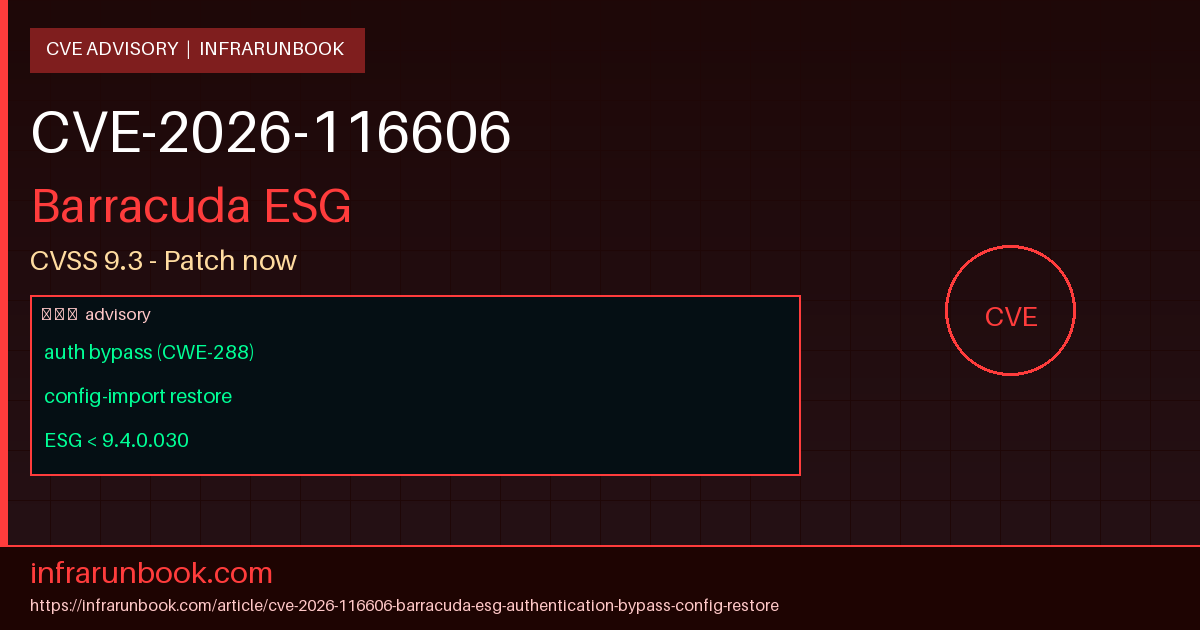
- CVE ID(s): CVE-2026-116606
- Severity: 9.3 CRITICAL (CVSS 4.0). Vector:
CVSS:4.0/AV:N/AC:L/AT:N/PR:N/UI:N/VC:H/VI:H/VA:H/SC:N/SI:N/SA:N
- Vendor / product: Barracuda Networks / Barracuda Email Security Gateway (ESG)
- Affected versions: All versions earlier than 9.4.0.030
- Fixed / patched versions: Not stated in the advisory - check the vendor page. The affected range ends before 9.4.0.030, so 9.4.0.030 or later is outside the affected range.
- Exploited in the wild: No known exploitation (not listed in CISA KEV)
- Attack vector: Network. No authentication needed. No user interaction.
- Published by: Mandiant (CNA), 2026-11-02
- Official advisory: Barracuda security advisory
What is this vulnerability?
CVE-2026-116606 is an authentication bypass in Barracuda Email Security Gateway. It is classed as CWE-288: Authentication Bypass Using an Alternate Path or Channel.
An unauthenticated remote attacker can invoke a configuration-import function. They can then restore a crafted, compatible backup archive. The result is unauthorized modification of the appliance's global configuration.
Barracuda reported the issue to Mandiant on 2026-10-22. The CVE and the Mandiant advisory (MNDT-2026-0042) were published on 2026-11-02.
The Barracuda advisory page text could not be read when this article was prepared. The details here come from the CVE record and the Mandiant disclosure. Read the vendor page directly for fixed-version and remediation guidance.
How does it affect you?
The attacker needs no account, no credentials and no user action. The score is 9.3 because confidentiality, integrity and availability of the appliance are all rated high.
An email gateway sits in the mail path. Its global configuration controls how mail is filtered, routed and handled. An attacker who can replace that configuration may be able to change that behavior. The sources do not describe specific outcomes, so treat any change you did not make as a sign of compromise.
Mandiant rates both impact and exploitability as High. The flaw is reachable over the network without authentication.
Realistic risk depends on exposure. An appliance whose management interface is reachable from the internet is at the most risk. One limited to a trusted admin network is at lower risk, but it is still affected.
As of the record update on 2026-11-03, the CVE is not listed in CISA's Known Exploited Vulnerabilities catalog. That can change, so patch promptly.
Who is affected?
- Anyone running Barracuda Email Security Gateway (ESG) at a version earlier than 9.4.0.030.
- The CVE record lists the default status as unaffected, with all versions below 9.4.0.030 affected.
The sources do not say whether other Barracuda products are affected. They do not say whether deployment type (hardware, virtual or cloud) matters. Check the vendor advisory for those details.
How to check if you are vulnerable
- Log in to the appliance's administration interface and find the firmware version. Barracuda shows this in the web interface.
- Compare it to 9.4.0.030. Any version earlier than that is affected.
- Identify which of your ESG appliances have management or web interfaces reachable from untrusted networks. Prioritize those.
- Check the vendor advisory for any further version guidance, since the advisory text was not readable when this article was written.
A version check only tells you whether you are exposed. It does not tell you whether the configuration was already tampered with. See the next section for that.
How to fix and recover
The advisory names no specific fixed version. The affected range stops below 9.4.0.030. Confirm the exact target release on the Barracuda advisory page before you schedule the upgrade.
- Back up first. Export your current configuration and store it offline.
- Upgrade. Move the appliance to the fixed release listed by Barracuda, using the vendor's update process.
- Verify. Confirm the version in the administration interface after the update and the reboot, if one is required.
- Review the configuration. Compare current settings with a known-good backup or documented baseline. Look at mail routing, filtering rules, allow and block lists, admin accounts, and outbound relay settings.
- Check for restores you did not trigger. Review appliance logs and audit records for configuration import or restore events at times when no admin was working.
- If you find changes you cannot explain: restore a known-good configuration after patching. Rotate administrator passwords, API tokens, and any credentials or keys stored on or used by the appliance. Treat the appliance as potentially compromised and follow your incident process.
Patch before you restore a known-good config. Otherwise the same flaw could be used to overwrite it again.
Workarounds and mitigations
The CVE record lists no workarounds. Patching is the fix.
While you prepare the upgrade, these general steps reduce exposure. They are not vendor-endorsed workarounds for this CVE.
- Restrict access to the appliance's management and web interfaces to trusted admin networks using firewall rules.
- Remove any direct internet exposure of administration services.
- Raise logging and alerting on the appliance and on the firewalls in front of it.
Check the Barracuda advisory for any official interim guidance.
What to monitor
- Configuration import or restore events in appliance logs, especially from unexpected source addresses or outside change windows.
- Unexpected changes to global settings, such as mail routing, filtering policies, admin users and relay settings.
- Unauthenticated requests to the appliance's management interface from external addresses, in firewall and web logs.
- Unusual mail flow, such as mail being rerouted, bypassing filters, or going to unfamiliar destinations.
- CISA's KEV catalog and the Barracuda and Mandiant pages, in case exploitation is reported or the advisory is updated.