
At a glance
- CVE ID(s): CVE-2026-126254, CVE-2026-126253, CVE-2026-126259
- Severity: CVE-2026-126254: 9.6 CRITICAL, CVSS:3.1/AV:N/AC:L/PR:L/UI:N/S:C/C:N/I:H/A:H/E:F/RL:O/RC:C. CVE-2026-126253: 9.3 CRITICAL, CVSS:3.1/AV:A/AC:L/PR:N/UI:N/S:C/C:N/I:H/A:H/E:P/RL:O/RC:C. CVE-2026-126259: 9.0 CRITICAL, CVSS:3.1/AV:N/AC:L/PR:N/UI:N/S:U/C:H/I:H/A:H/E:U/RL:O/RC:C.
- Vendor / product: Fortinet FortiOS
- CVE-2026-126254 (9.6) affected: FortiOS 8.0.0 through 8.0.1, 7.6.0 through 7.6.7, 7.4.0 through 7.4.12, 7.2.0 through 7.2.13. Fixed: 8.0.2, 7.6.8, 7.4.13, 7.2.14 or above.
- CVE-2026-126253 (9.3) affected: FortiOS 8.0.0 through 8.0.1, 7.6.0 through 7.6.7, 7.4.0 through 7.4.12, 7.2.0 through 7.2.13, 7.0.1 through 7.0.19. Fixed: 8.0.2, 7.6.8, 7.4.13, 7.2.14 or above. For 7.0: Not stated in the advisory - check the vendor page.
- CVE-2026-126259 (9.0) affected: FortiOS 8.0.0, 7.6.0 through 7.6.7, 7.4.0 through 7.4.12, 7.2.0 through 7.2.13, 7.0.0 through 7.0.19. Fixed: 8.0.1, 7.6.8, 7.4.13, 7.2.14 or above. For 7.0: Not stated in the advisory - check the vendor page.
- Exploited in the wild: No known exploitation (none of the three is listed in CISA KEV).
- Attack vector: CVE-2026-126254: network, low privileges (a configured iBGP neighbor), no user interaction. CVE-2026-126253: adjacent network, no authentication, no user interaction. CVE-2026-126259: network, no authentication, no user interaction.
- Published by: Fortinet (CNA), 2026-11-11
- Official advisories: FG-IR-26-268, FG-IR-26-267, FG-IR-26-273
What is this vulnerability?
Fortinet disclosed three separate critical flaws in FortiOS on 2026-11-11. They share the same affected release trains, so one upgrade plan covers them.
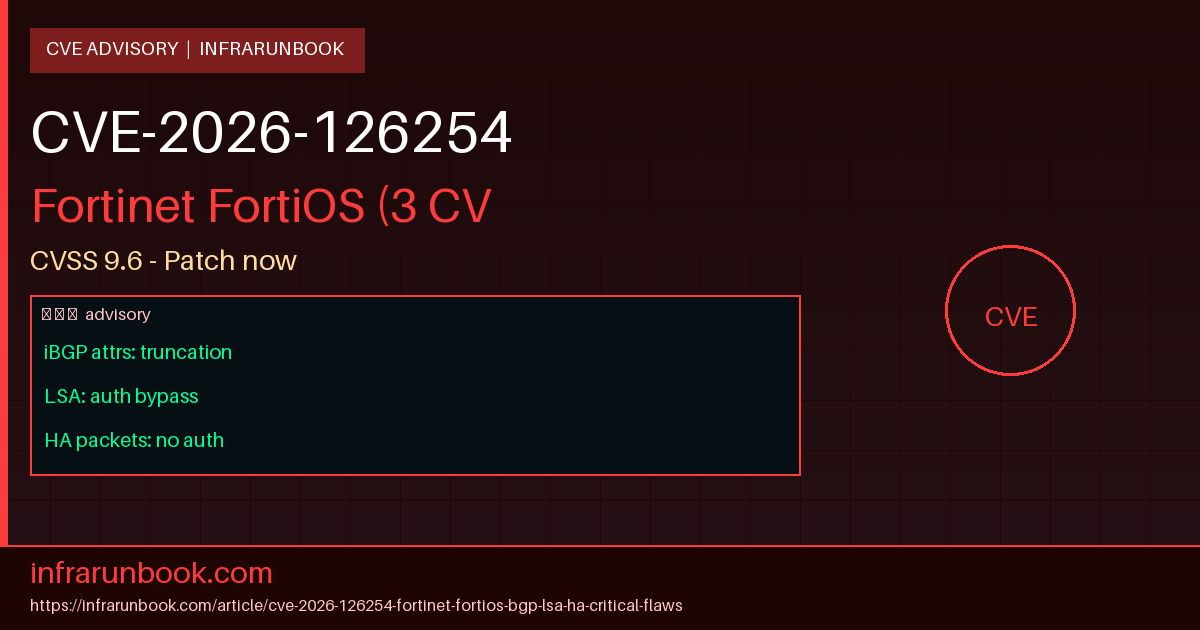
CVE-2026-126254 is a numeric truncation error (CWE-197). A configured iBGP neighbor may be able to send malicious or malformed attributes to all connected routers through a specially crafted request. The scope is marked as changed, which means the impact can reach beyond the FortiOS device itself.
CVE-2026-126253 is an authentication bypass by primary weakness (CWE-305). An unauthenticated attacker may be able to broadcast LSAs (link-state advertisements) through a specially crafted request. Scope is also changed here.
CVE-2026-126259 is a missing authentication for a critical function (CWE-306). An unauthenticated attacker may be able to execute commands as super admin through crafted HA packets. The advisory ties this to devices with HA FGSP plus standalone-config-sync, or to autoscale deployments.
How does it affect you?
The first two flaws hit the routing plane. Integrity and availability impact are both rated high. Bad BGP attributes or forged LSAs can corrupt routing information on peers beyond the firewall, break reachability, or redirect traffic. Because scope is changed, the blast radius is your wider routed network.
CVE-2026-126259 is the most severe in practical terms if you match its conditions. Super admin command execution means full device takeover: confidentiality, integrity and availability are all rated high. It needs no credentials and works over the network.
Realistic risk depends on your design:
- CVE-2026-126254 needs a configured iBGP neighbor. The vector shows low privileges required. A compromised or misconfigured internal peer is the likely path.
- CVE-2026-126253 has an adjacent attack vector. The attacker needs to be on the same network segment as the device.
- CVE-2026-126259 is limited to HA FGSP with standalone-config-sync, or autoscale. If you do not use those, exposure is lower. Confirm this against the advisory.
No exploitation is known and none of the three is in CISA KEV. The vector for CVE-2026-126254 carries a temporal exploit-maturity value of F (functional). Treat that as a reason not to wait.
Who is affected?
Anyone running FortiOS in these ranges:
- 8.0.0 through 8.0.1 (CVE-2026-126254, CVE-2026-126253). For CVE-2026-126259, only 8.0.0 is listed.
- 7.6.0 through 7.6.7
- 7.4.0 through 7.4.12
- 7.2.0 through 7.2.13
- 7.0.1 through 7.0.19 (CVE-2026-126253) and 7.0.0 through 7.0.19 (CVE-2026-126259). No fixed 7.0 build is named. Not stated in the advisory - check the vendor page.
The record lists no affected platforms beyond FortiOS itself. Practical exposure is highest for devices running BGP with iBGP neighbors, devices that exchange link-state routing, and HA clusters using FGSP with standalone-config-sync or autoscale groups.
How to check if you are vulnerable
First, get the running version on each device.
get system statusCompare the version against the ranges above. Then check which features are in use:
- BGP: look at your BGP configuration and neighbor list for iBGP peers.
- Link-state routing: check whether the device runs a dynamic routing protocol that floods LSAs on connected segments.
- HA: review the HA configuration for FGSP and standalone-config-sync, and check whether the device is part of an autoscale deployment.
get router info bgp summary
get system ha status
If you cannot tell whether a feature is in scope, assume you are affected and patch.
How to fix and recover
Upgrade to a fixed release for your train:
- FortiOS 8.0: 8.0.2 or above (8.0.1 or above is stated for CVE-2026-126259 only)
- FortiOS 7.6: 7.6.8 or above
- FortiOS 7.4: 7.4.13 or above
- FortiOS 7.2: 7.2.14 or above
- FortiOS 7.0: Not stated in the advisory - check the vendor page. Plan a move to a fixed train.
Steps:
- Back up the current configuration.
- Check the upgrade path in the Fortinet release notes for your current build.
- Upgrade HA clusters in the order Fortinet documents, in a maintenance window.
- Run
get system status
to confirm the new version. - Check that BGP sessions are established and that routing tables look as expected.
- Confirm HA sync is healthy.
If you suspect compromise, especially on HA FGSP or autoscale devices exposed before patching:
- Review admin accounts for ones you did not create.
- Compare the running configuration to a known-good backup. Restore the known-good config if it differs without explanation.
- Rotate admin passwords, API tokens, and any keys or pre-shared secrets stored on the device, including BGP and HA authentication secrets.
- Review routing tables on peers for unexpected prefixes, attributes or LSAs from the affected period.
Workarounds and mitigations
The advisories list no workarounds. Patching is the fix.
While you schedule the upgrade, you can reduce exposure with general measures. These are not vendor-stated fixes:
- Limit who can reach HA heartbeat and sync links. Keep them on dedicated, isolated segments.
- Review your iBGP neighbor list. Remove peers you do not need.
- Keep untrusted hosts off segments where the device exchanges routing information.
- Restrict management access to trusted networks.
What to monitor
- Unexpected BGP session resets, or UPDATE messages with odd attributes from iBGP peers.
- New or changed routes on peers that you cannot explain.
- Unexpected LSAs or topology changes in your link-state routing domain.
- HA events: unexpected cluster state changes, config sync events, or new cluster members.
- New admin users, config changes you did not make, and unexpected CLI activity in system logs.
- Device crashes or restarts of routing processes.
- Fortinet PSIRT updates, in case exploitation or a 7.0 fix is announced.
References
- https://fortiguard.fortinet.com/psirt/FG-IR-26-268 (CVE-2026-126254)
- https://fortiguard.fortinet.com/psirt/FG-IR-26-267 (CVE-2026-126253)
- https://fortiguard.fortinet.com/psirt/FG-IR-26-273 (CVE-2026-126259)