
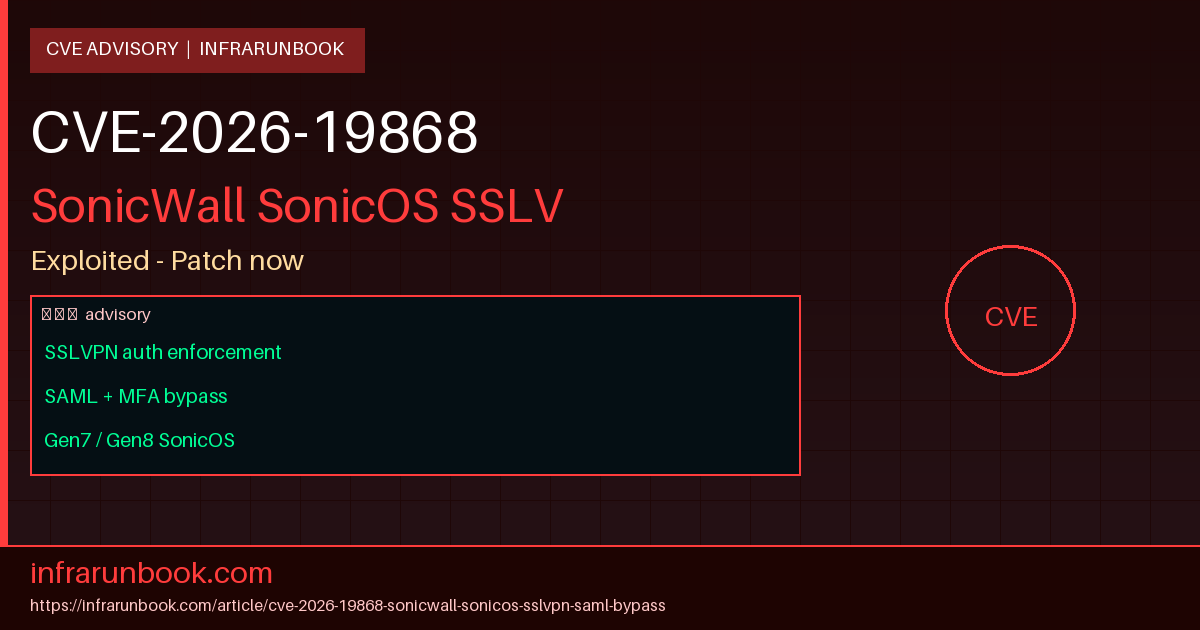
At a glance
- CVE ID(s): CVE-2026-19868
- Severity: CVSS score and vector not stated in the advisory - check the vendor page. Treat it as high priority because it is exploited in the wild.
- Vendor / product: SonicWall SonicOS (SSLVPN service), platforms Gen7 and Gen8
- Affected versions: Gen7: 7.3.3-7015 and older versions. Gen8: 8.2.2-8015 and older versions.
- Fixed / patched versions: Not stated in the advisory - check the vendor page
- Exploited in the wild: Yes - listed in CISA KEV
- Attack vector: Authentication needed. The attacker must hold valid credentials for an alternate authentication method. Network vector and user interaction are not stated in the advisory - check the vendor page.
- Published by: sonicwall (CNA), 2026-11-06
- Official advisory: SNWLID-2026-0014
What is this vulnerability?
CVE-2026-19868 is an authentication enforcement flaw in the SonicOS SSLVPN service. It is classed as CWE-308.
The SSLVPN service can be set up to authenticate users through SAML. With this flaw, a user who has valid credentials for a different, alternate authentication method may get around the SAML authentication controls. The advisory also says that a successful attack may bypass multi-factor authentication (MFA) when that MFA is enforced through SAML.
In plain terms: the SAML step is meant to be the gate. The flaw lets someone reach the VPN by using another login method instead, and skip that gate.
The advisory does not give further technical detail, and this article does not guess at any.
How does it affect you?
The impact is a bypass of access controls on your VPN. If you rely on SAML to enforce MFA or to tie VPN logins to your identity provider, that protection may not hold.
Realistic risk depends on your setup:
- An attacker needs valid credentials for an alternate authentication method. That is a real barrier, but stolen or reused credentials are common.
- If MFA is enforced only through SAML, the second factor may be skipped. A stolen password could then be enough.
- A successful login gives the attacker a VPN session. What they can reach depends on your VPN access rules and network layout.
This CVE is listed in CISA's Known Exploited Vulnerabilities catalog. Attacks have been seen. Do not wait for a routine maintenance window.
The advisory data does not state a CVSS score, and it does not say whether this has been used in ransomware attacks. The record shows no known ransomware use.
Who is affected?
You are in scope if you run SonicWall firewalls with SonicOS on these platforms and versions:
- Gen7: SonicOS 7.3.3-7015 and older versions
- Gen8: SonicOS 8.2.2-8015 and older versions
The flaw sits in the SSLVPN service, and the advisory describes it in terms of SAML authentication. Devices that do not run SSLVPN, or do not use SAML for it, may be less exposed. The advisory text provided here does not say so explicitly. Confirm with the vendor page before you rule a device out.
How to check if you are vulnerable
- List every SonicWall firewall you manage. Note whether each is Gen7 or Gen8.
- Read the SonicOS firmware version on each device from the management interface, in the system status or firmware section.
- Compare it to the affected ranges above. Gen7 at 7.3.3-7015 or older, and Gen8 at 8.2.2-8015 or older, are affected.
- Check whether the SSLVPN service is enabled and whether it uses SAML authentication.
- Check whether other authentication methods, such as local users or a directory, are also allowed on the SSLVPN service. The flaw involves credentials for an alternate method.
Use this simple record for each device:
Device name:
Platform (Gen7/Gen8):
SonicOS version:
SSLVPN enabled (yes/no):
SAML auth used for SSLVPN (yes/no):
Alternate auth methods allowed (list):
Status (affected / not affected / needs check):
How to fix and recover
The advisory data does not list fixed versions. Fixed / patched versions: Not stated in the advisory - check the vendor page.
- Open the vendor advisory, SNWLID-2026-0014, and find the fixed firmware for your platform.
- Back up the current configuration before you upgrade.
- Upgrade each affected device to the fixed release named by the vendor. Do internet-facing VPN devices first.
- After the upgrade, confirm the new firmware version in the management interface.
- Test a SAML VPN login with a normal user and confirm that the MFA prompt still appears.
Because the flaw is exploited in the wild, assume a compromise is possible on any unpatched device that had SSLVPN reachable from the internet.
- Review SSLVPN login logs for the period before you patched. Look for logins that used an alternate authentication method for users who normally log in through SAML.
- Look for successful VPN logins with no matching event at your identity provider.
- Reset passwords for accounts that show suspicious logins. Revoke their active sessions.
- Rotate credentials stored on the firewall, such as local account passwords and any service or directory bind accounts, if you find signs of misuse.
- If the configuration looks changed in ways you did not make, restore a known-good configuration backup and then re-apply the patch.
- Check internal systems that VPN users can reach for unusual access.
Workarounds and mitigations
The advisory data lists no workarounds. Do not rely on a workaround in place of the patch.
These general steps can lower risk until you patch. They are not vendor-confirmed fixes for this CVE:
- Remove alternate authentication methods from the SSLVPN service where you do not need them, so that SAML is the only path. Confirm the effect in a test first.
- Limit which source addresses can reach the SSLVPN service, if your users allow it.
- Disable the SSLVPN service on devices that do not need it.
- Do not treat SAML-enforced MFA as your only control for sensitive internal systems. Add MFA or access limits at the application layer.
Check the vendor page for any official guidance before you change production settings.
What to monitor
- SSLVPN authentication logs: successful logins, the authentication method used, and the source IP.
- Logins that bypass your normal SAML flow, or that have no matching sign-in at your identity provider.
- Logins from new countries, hosting providers or unusual hours.
- Many failed attempts followed by a success on the same account.
- Unexpected firewall configuration changes, new local users, or new access rules.
- Unusual traffic from VPN address pools to internal servers, especially admin and file services.
- Updates to the SonicWall advisory and the CISA KEV entry, in case fixed versions or further guidance appear.