
At a glance
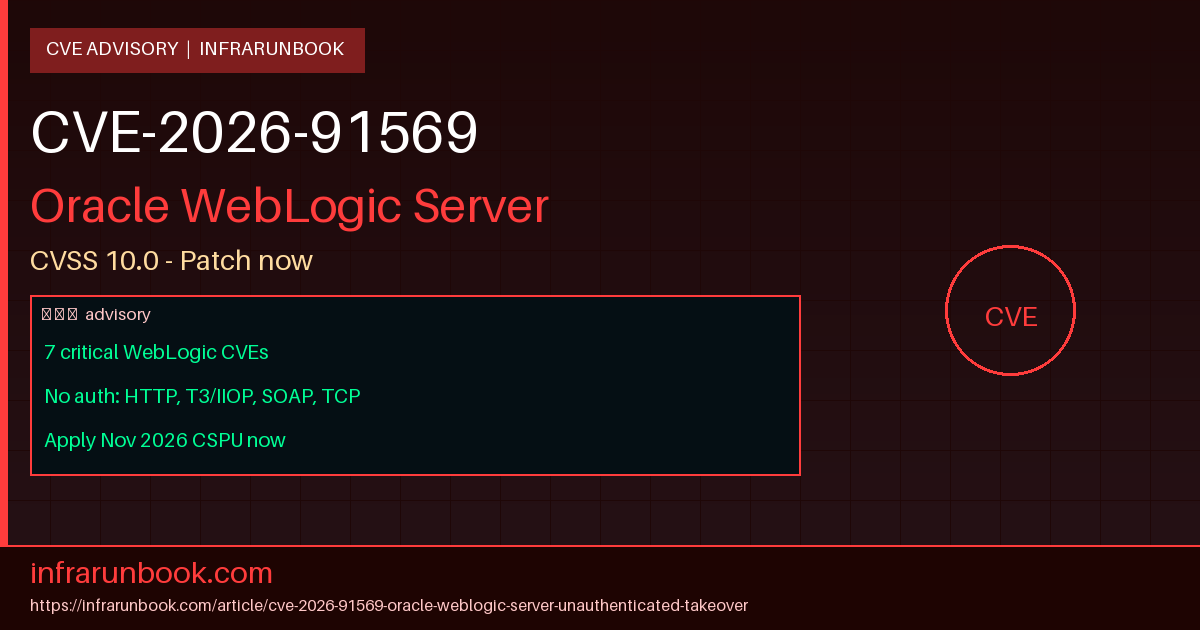
- CVE ID(s): CVE-2026-91569, CVE-2026-91583, CVE-2026-91470, CVE-2026-91570, CVE-2026-91585, CVE-2026-91456, CVE-2026-91469
- CVE-2026-91569: CVSS 10.0 CRITICAL (CVSS:3.1/AV:N/AC:L/PR:N/UI:N/S:C/C:H/I:H/A:H). Component: TopLink Integration, via HTTP, scope change. Affected: 12.2.1.4.0, 14.1.1.0.0, 14.1.2.0.0, 15.1.1.0.0. Fixed: Not stated in the advisory - check the vendor page.
- CVE-2026-91583: CVSS 9.8 CRITICAL (CVSS:3.1/AV:N/AC:L/PR:N/UI:N/S:U/C:H/I:H/A:H). Component: TopLink Integration, via HTTP. Affected: 12.2.1.4.0, 14.1.1.0.0, 14.1.2.0.0, 15.1.1.0.0. Fixed: Not stated in the advisory - check the vendor page.
- CVE-2026-91470: CVSS 9.8 CRITICAL (CVSS:3.1/AV:N/AC:L/PR:N/UI:N/S:U/C:H/I:H/A:H). Component: Core, via T3 and IIOP. Affected: 12.2.1.4.0, 14.1.1.0.0, 14.1.2.0.0, 15.1.1.0.0. Fixed: Not stated in the advisory - check the vendor page.
- CVE-2026-91570: CVSS 9.8 CRITICAL (CVSS:3.1/AV:N/AC:L/PR:N/UI:N/S:U/C:H/I:H/A:H). Component: TopLink Integration, via HTTP. Affected: 12.2.1.4.0, 14.1.1.0.0, 14.1.2.0.0, 15.1.1.0.0. Fixed: Not stated in the advisory - check the vendor page.
- CVE-2026-91585: CVSS 9.8 CRITICAL (CVSS:3.1/AV:N/AC:L/PR:N/UI:N/S:U/C:H/I:H/A:H). Component: TopLink Integration, via TCP. Affected: 12.2.1.4.0, 14.1.1.0.0, 14.1.2.0.0, 15.1.1.0.0. Fixed: Not stated in the advisory - check the vendor page.
- CVE-2026-91456: CVSS 9.8 CRITICAL (CVSS:3.1/AV:N/AC:L/PR:N/UI:N/S:U/C:H/I:H/A:H). Component: Core, via SOAP. Affected: 12.2.1.4.0, 14.1.1.0.0, 14.1.2.0.0, 15.1.1.0.0. Fixed: Not stated in the advisory - check the vendor page.
- CVE-2026-91469: CVSS 9.4 CRITICAL (CVSS:3.1/AV:N/AC:L/PR:N/UI:N/S:U/C:L/I:H/A:H). Component: Core, via HTTP. Affected: 12.2.1.4.0, 14.1.1.0.0, 14.1.2.0.0, 15.1.1.0.0. Fixed: Not stated in the advisory - check the vendor page.
- Severity: All seven are rated CRITICAL. Scores range from 9.4 to 10.0.
- Vendor / product: Oracle Corporation - Oracle WebLogic Server (Oracle Fusion Middleware)
- Affected versions: 12.2.1.4.0, 14.1.1.0.0, 14.1.2.0.0 and 15.1.1.0.0 (supported versions listed by Oracle)
- Fixed / patched versions: Not stated in the advisory - check the vendor page
- Exploited in the wild: No known exploitation
- Attack vector: Network. No authentication needed. No user interaction needed. Attack complexity is low.
- Published by: Oracle (CNA), 2026-11-17
- Official advisory: Oracle Critical Security Patch Update Advisory - November 2026
What is this vulnerability?
This is a batch of seven critical vulnerabilities in Oracle WebLogic Server. Oracle fixed them in its November 2026 Critical Security Patch Update (CSPU). Oracle describes a CSPU as a smaller, targeted set of high-priority security fixes. CSPUs sit alongside Oracle's quarterly cumulative Critical Patch Updates (CPUs).
The flaws are in two WebLogic components:
- TopLink Integration: CVE-2026-91569, CVE-2026-91583, CVE-2026-91570 (all via HTTP) and CVE-2026-91585 (via TCP).
- Core: CVE-2026-91470 (via T3 and IIOP), CVE-2026-91456 (via SOAP) and CVE-2026-91469 (via HTTP).
Oracle calls all seven "easily exploitable". An unauthenticated attacker only needs network access to the affected protocol. Oracle has not published the root cause or bug class for any of them. The CVE records give no CWE ID. We will not guess at the internals.
CVE-2026-91569 is the top-rated one at CVSS 10.0. It has a scope change. Oracle says an attack on WebLogic "may significantly impact additional products". In practice, that means the applications and systems WebLogic hosts or connects to are also at risk.
How does it affect you?
Six of the seven CVEs (CVE-2026-91569, -91583, -91470, -91570, -91585, -91456) end in takeover of Oracle WebLogic Server. That is full loss of confidentiality, integrity and availability. An attacker who takes over WebLogic can usually read data sources and stored credentials, change deployed applications, and use the server as a pivot point into internal networks.
CVE-2026-91469 (CVSS 9.4) is a little narrower. Oracle says it allows unauthorized creation, deletion or modification of critical data or all WebLogic-accessible data. It also allows unauthorized read access to a subset of that data, and a hang or repeatable crash (complete DoS).
Realistic risk: none of these CVEs is listed as exploited in the wild today. But WebLogic has a long history as a target. Its admin consoles, T3/IIOP listeners and HTTP endpoints are often reachable from places they should not be. Oracle's own advisory warns that attackers keep going after Oracle vulnerabilities that already have patches, and sometimes succeed because customers did not patch. Treat any internet-facing WebLogic instance as urgent.
Who is affected?
Anyone running Oracle WebLogic Server in these supported versions:
- 12.2.1.4.0
- 14.1.1.0.0
- 14.1.2.0.0
- 15.1.1.0.0
All seven CVEs list the same four versions. Oracle only rates supported versions. If you run an older, unsupported release, assume you are exposed and that no fix will come for your version.
Remember that WebLogic is often embedded in other Oracle products. Many Fusion Middleware components, and applications built on them, run on a WebLogic domain. The November 2026 CSPU lists a long set of other affected Oracle products. If any of them run on an affected WebLogic version, the WebLogic patches apply to them too.
How to check if you are vulnerable
- Inventory WebLogic installs. Find every Oracle Home that has WebLogic Server, including those under other Fusion Middleware products.
- Get the version. On each host, as the WebLogic install owner, set the environment and print the version:
. $ORACLE_HOME/wlserver/server/bin/setWLSEnv.sh
java weblogic.version- List installed patches. Compare the output against the patch numbers in Oracle's Patch Availability Document for the November 2026 CSPU:
$ORACLE_HOME/OPatch/opatch lspatches- Map exposure. Check which listen ports each Admin Server and Managed Server uses (see the domain's config.xml or the Administration Console). Then find out what can reach them over HTTP, T3, IIOP, SOAP and other TCP channels. Pay extra attention to anything reachable from the internet or from user networks.
If the version matches one of the four listed above and the November 2026 CSPU patches are missing, treat the server as vulnerable.
How to fix and recover
- Get the patches. Open the November 2026 CSPU advisory and follow the Patch Availability Document link for Fusion Middleware / WebLogic Server. The exact patch numbers and fixed builds are on My Oracle Support. They are not stated in the CVE records.
- Patch in priority order. Start with internet-facing servers, then servers reachable from user or partner networks, then internal-only ones.
- Apply with OPatch. Follow the patch README exactly. Stop the affected servers, apply the patch, and restart Node Manager, the Admin Server and the Managed Servers as the README says.
- Verify. Run
opatch lspatches
again and confirm the new patch IDs are there. Check the server logs for clean startup and smoke-test your applications. - Also apply the related Security Alerts. Oracle advises customers to apply the Security Alert patches released in October 2026 together with this CSPU, where the affected products apply to you.
If a server was exposed and unpatched, assume it may have been compromised:
- Rotate WebLogic admin credentials, data source passwords, keystore passwords, and any keys or secrets stored in the domain.
- Review access logs, server logs and domain logs for unexpected requests, new deployments or config changes.
- Compare deployed applications and domain config against a known-good baseline. Rebuild from known-good config if anything does not match.
- Because CVE-2026-91569 has a scope change, also check the downstream systems WebLogic talks to.
Workarounds and mitigations
The CVE records list no official workarounds. Patching is the fix. Until you can patch, cut down exposure:
- Remove direct internet access to WebLogic listen ports. Put only the needed application paths behind a reverse proxy or load balancer.
- Block T3 and IIOP from untrusted networks (relevant to CVE-2026-91470). WebLogic connection filters or upstream firewalls can do this. Disable IIOP if you do not use it.
- Limit SOAP/web service endpoints and other HTTP paths to the clients that need them (relevant to CVE-2026-91456, -91469 and the TopLink HTTP CVEs).
- Restrict raw TCP access to WebLogic hosts to known sources (relevant to CVE-2026-91585).
- Keep the Administration Console on a separate management network.
These steps reduce risk. They do not fix the flaws.
What to monitor
- Inbound T3 and IIOP connections from sources outside your trusted ranges.
- Unusual HTTP or SOAP request volume, errors or odd paths hitting WebLogic.
- New or changed application deployments, new users or role changes in the security realm.
- Unexpected child processes or outbound connections started by the WebLogic Java process.
- Repeated server hangs or crashes (possible sign of CVE-2026-91469 DoS attempts).
- CISA's Known Exploited Vulnerabilities catalog and Oracle's advisory page, for any change in exploitation status.